
Is UK Data Centre Real Estate a Good Investment for Private Capital?

UK data centre real estate can be attractive to private capital because it combines property-backed exposure with long-term demand for cloud computing, artificial intelligence and digital services. It is not a conventional industrial investment: returns depend heavily on power availability, grid timing, planning, connectivity, cooling design, tenant credit and the operator’s technical capability.
TL;DR
- Power that is deliverable within an investable timetable is usually more valuable than an unverified grid-capacity headline.
- London and the Slough corridor form the UK’s principal data centre cluster, while regional markets can support edge, enterprise and resilience strategies.
- Private investors can participate through stabilised assets, development joint ventures, powered land, debt or listed and unlisted vehicles.
- Income quality depends on the contract, counterparty and operating model—not simply the building or headline lease length.
- Data centres require specialist diligence covering energy, fibre, planning, cooling, security, sustainability and technological obsolescence.
Why private capital is targeting UK data centres
Demand for data centre capacity is being supported by cloud migration, artificial intelligence workloads, streaming, cybersecurity, financial services and the wider digitisation of business. These drivers make the sector relevant to family offices, GCC investors and institutional capital seeking exposure beyond conventional offices, logistics, Build-to-Rent, HMOs or PBSA.
The UK has several durable advantages: a large digital economy, deep capital markets, international fibre connections, an established technology and financial-services base, and English-law contracts. London is also a major global connectivity and cloud market. CBRE, JLL, Knight Frank, Savills and Colliers regularly treat data centres as a distinct operational real-estate or infrastructure segment rather than standard warehousing.
Yet digital demand does not automatically make every site investable. The supply of usable capacity is constrained by electricity networks, planning, equipment lead times, water and cooling considerations, local opposition, and the availability of technically capable operators. A site with an attractive postcode but no credible energisation pathway may have limited near-term value as a data centre.
Structural demand indicators to monitor
- Cloud and AI adoption: Track operator announcements and contracted requirements rather than extrapolating from general technology forecasts.
- Electricity demand: Review capacity in megawatts, but distinguish requested, reserved, contracted and energised power.
- Vacancy and take-up: Use specialist market reports from CBRE, JLL, Knight Frank, Savills and Cushman & Wakefield, noting that methodologies differ.
- Grid policy: Follow Ofgem, the National Energy System Operator and the relevant distribution network operator.
- Planning policy: Check the National Planning Policy Framework on gov.uk and the relevant local planning authority’s adopted and emerging policies.
Where are the main UK data centre markets?
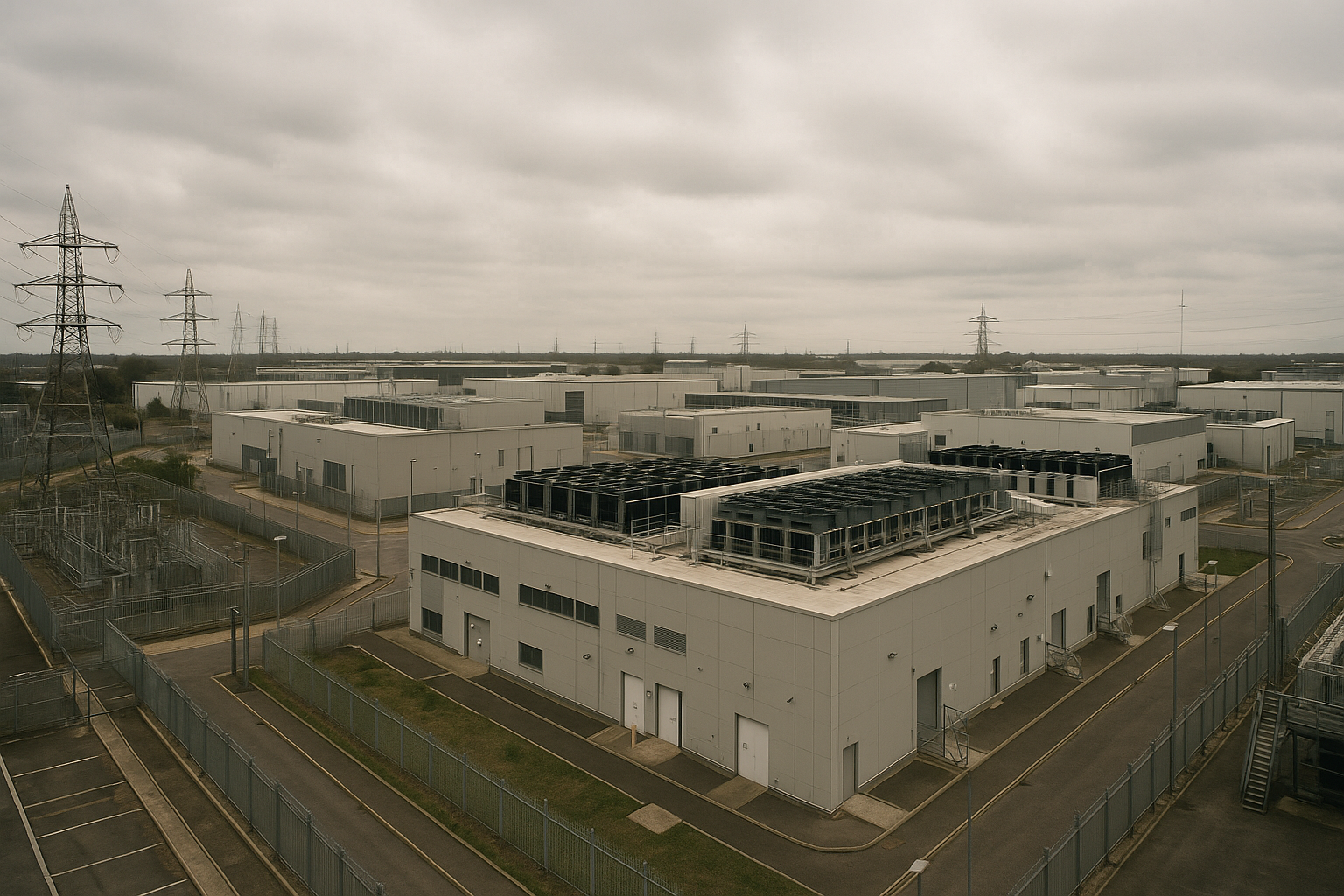
London and the western corridor—particularly Slough and adjoining parts of the Thames Valley—remain the country’s core data centre geography. The cluster benefits from connectivity, enterprise demand, cloud ecosystems and an established operator base. Scarce land and constrained power can, however, increase entry costs and extend development timetables.
Regional cities including Manchester, Birmingham and Leeds offer corporate demand, connectivity and proximity to large populations. Liverpool, Sheffield and Nottingham may also support selected edge, enterprise, disaster-recovery or specialist facilities, although they do not have the same depth of hyperscale ecosystem as London. Site selection should be driven by customer and network requirements, not a generic regional-growth thesis.
| Market | Typical strategic role | Principal opportunity | Principal constraint | |—|—|—|—| | London | Major cloud, colocation and enterprise hub | Deep connectivity and customer ecosystem | Land cost, planning and power availability | | Slough and Thames Valley | Established hyperscale and colocation cluster | Operator concentration and fibre routes | Grid constraints and intense site competition | | Manchester | Northern enterprise, cloud and edge market | Large economy and established digital sector | Shallower demand pool than London | | Birmingham | Midlands enterprise and edge location | Central geography and broad business base | Site-specific power and connectivity requirements | | Leeds | Financial, public-sector and regional workloads | Strong services economy | Smaller operator and customer ecosystem | | Liverpool, Sheffield and Nottingham | Selective edge, resilience or enterprise uses | Lower land costs in suitable locations | Demand depth and exit liquidity must be proven |
Proximity alone is insufficient. Two neighbouring plots can have materially different investment prospects because they connect to different substations, face different reinforcement works or have unequal fibre access. Investors should therefore underwrite the precise parcel and connection route rather than apply a broad city-level assumption.
How private capital can access the sector

The appropriate entry route depends on risk tolerance, target returns, technical resources and investment duration. Direct development offers the greatest control and potentially the highest return, but it also carries the heaviest power, construction, leasing and operating risk.
| Route | Income profile | Main risks | Potential fit | |—|—|—|—| | Stabilised, leased asset | Existing contracted income | Tenant credit, rent structure and re-letting risk | Core or long-income capital | | Powered-shell development | Income begins after construction and leasing | Grid, planning, cost and vacancy risk | Value-add investors with technical partners | | Fully fitted operating facility | Property plus operational revenues | Technology, utilisation and operator execution | Specialist infrastructure or private-equity capital | | Powered land | Limited or no initial income | Connection certainty, planning and delivery timing | Patient opportunistic capital | | Joint venture with an operator | Depends on agreed structure | Alignment, governance and operator dependency | Family offices or institutions seeking sector expertise | | Senior or mezzanine debt | Contractual interest and repayment | Construction, covenant and collateral risk | Credit investors with specialist underwriting | | Listed or unlisted vehicle | Portfolio-level distributions | Manager, market and fee risk | Diversified or lower-governance exposure |
Data centre real estate vs conventional logistics
> Asset fundamentals > – Data centre: Value is strongly linked to secured power, fibre, technical design and operating capability. > – Logistics: Value is driven more conventionally by location, access, specification, rent and occupier demand. > > Capital expenditure > – Data centre: Mechanical and electrical systems can represent a substantial share of total project cost. > – Logistics: The shell normally accounts for a greater proportion of the landlord’s investment. > > Obsolescence > – Data centre: Cooling, rack density and power architecture can become outdated. > – Logistics: Functional obsolescence is generally slower and easier to benchmark. > > Re-letting > – Data centre: Customer migration can be operationally difficult, but specialist fit-out may narrow the future tenant pool. > – Logistics: A standard unit can often accommodate a broader range of occupiers.
The legal and economic boundary between real estate and infrastructure must be clear. Ownership of land and a powered shell is different from ownership of generators, uninterruptible power supplies, cooling systems, software, service contracts and customer relationships. Valuation, financing, tax and exit options can change materially depending on where those components sit.
Power, planning and connectivity determine site value
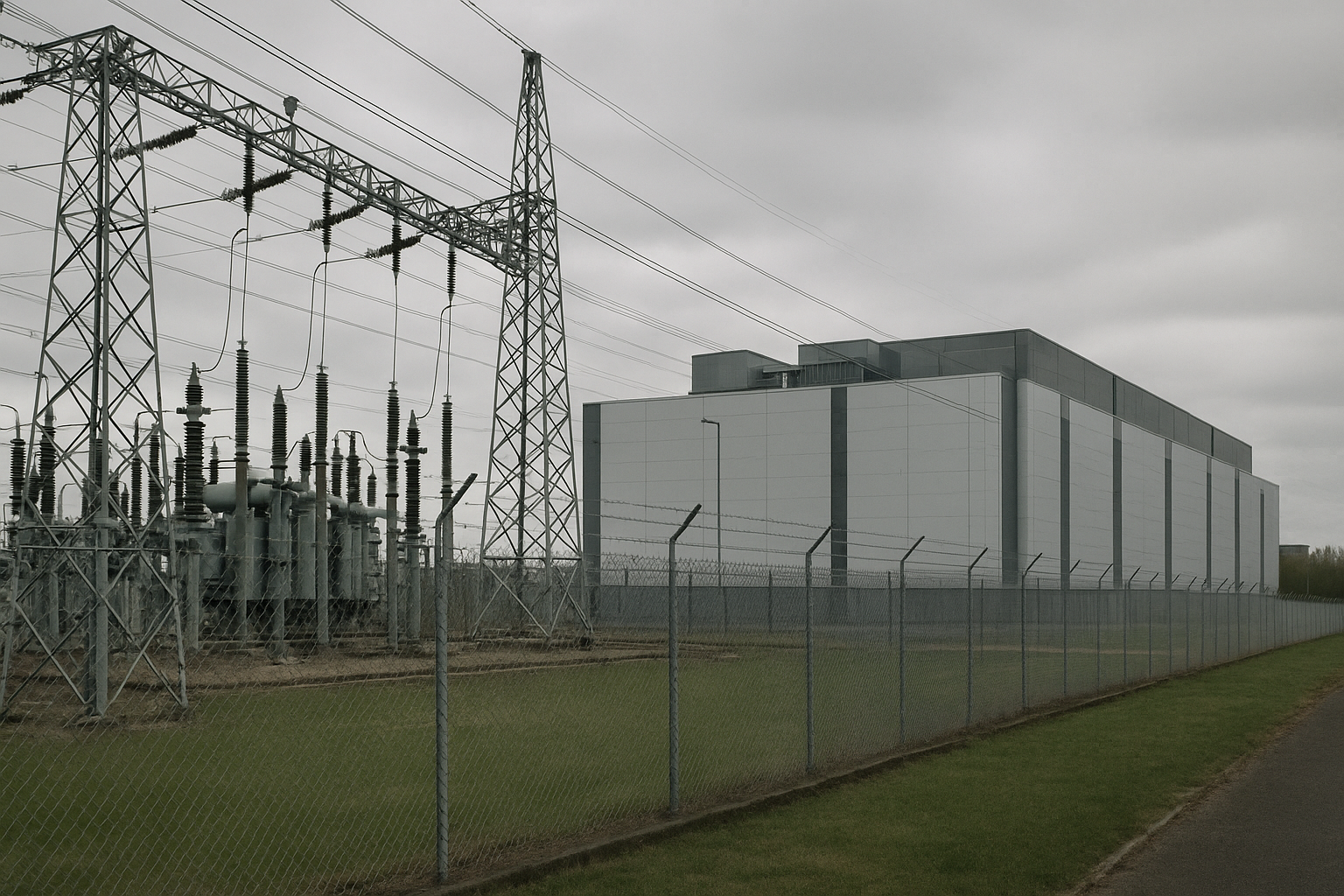
Power is usually the first gating item. Investors need evidence that capacity is not merely discussed but contractually secured, technically deliverable and aligned with the construction programme. National Grid operates the electricity transmission network in England and Wales, while regional distribution network operators control many local connections; the relevant counterparty depends on the project.
A credible grid offer should be examined for capacity, voltage, reinforcement obligations, milestone payments, security requirements, termination rights, energisation date and curtailment conditions. Investors should also establish whether the project depends on third-party land, easements or a new substation.
Planning can be equally decisive. Data centres may face scrutiny over energy demand, generators, emissions, noise, building massing, visual impact, water use, biodiversity and local employment. In 2024, the UK government identified data centres as Critical National Infrastructure, underlining their strategic importance, but this does not remove the need for local planning consent or environmental compliance.
Seven checks before acquiring a data centre site
- Verify the power position. Obtain and independently review the connection offer, accepted terms, deposits, works schedule and energisation assumptions.
- Map the connection route. Confirm substation location, cable route, easements, access rights and third-party dependencies.
- Test planning deliverability. Review land allocation, use classification, noise limits, generator strategy, height, massing and environmental conditions.
- Audit fibre diversity. Confirm genuinely separate routes and carriers rather than nominally diverse lines sharing one physical duct.
- Assess flood and climate risk. Use Environment Agency mapping and site-specific engineering for present and future hazards.
- Validate the technical concept. Test power usage, rack density, cooling method, redundancy and upgrade flexibility against target workloads.
- Align land and grid milestones. Structure completion, deferred consideration or options so that capital is not fully exposed before critical consents and capacity become certain.
How income, leases and value should be underwritten

Data centre cash flows can take several forms. A powered shell may be let on a conventional lease, while a colocation facility may earn recurring service revenue from multiple customers. Hyperscale arrangements can include capacity commitments, phased take-up, power pass-throughs, service-level obligations and expansion rights. These are economically different propositions.
Headline rent is therefore an incomplete measure. Underwriting should identify which party bears electricity costs, business rates, insurance, maintenance, lifecycle capital expenditure and compliance. It should also test indexation caps and collars, break rights, rent-free periods, security packages, parent guarantees and the consequences of failing service levels.
The tenant covenant requires technical as well as financial analysis. A strong corporate name may sit above a limited special-purpose tenant, while an operator can have substantial contractual revenues but equally substantial future capital obligations. The FCA regulates financial markets and certain investment structures, but direct property ownership is not made low-risk by regulatory perimeter alone; investors should obtain legal advice on any fund, security or promotional arrangement.
Illustrative underwriting layers
| Layer | Core question | Evidence required | |—|—|—| | Land | Can the facility be built and accessed? | Title, rights, surveys and planning review | | Power | Will the required capacity be delivered on time? | Executed connection documents and engineering diligence | | Building | Is the shell adaptable and insurable? | Design, warranties, fire strategy and reinstatement analysis | | Technical plant | Will systems meet contracted service levels? | Independent technical report and lifecycle plan | | Customer | Is demand binding and creditworthy? | Executed contracts, guarantees and churn analysis | | Operator | Can the facility be delivered and run reliably? | Track record, staffing, controls and incident history | | Exit | Who can buy the asset in its future form? | Comparable transactions and buyer mapping |
Valuation also requires caution. Traditional property yields can be misleading where a material part of earnings comes from services or depreciating equipment. RICS valuation principles remain relevant, but the instruction should use professionals experienced in data centres and clearly separate land, shell, plant and operating-business value.
Principal risks and mitigants

The strongest investment cases are often constrained not by demand but by execution. Private capital should expect a diligence process closer to infrastructure development than a standard commercial-property acquisition.
- Grid delay: Reinforcement works can move beyond the business plan. Mitigate through contractual milestones, contingency and staged land payments.
- Speculative power banking: A nominal reservation may not equal deliverable capacity. Require direct verification with the network counterparty.
- Construction inflation and procurement: Transformers, generators, switchgear and cooling systems can have long lead times. Secure procurement plans and robust contingencies.
- Technological change: AI workloads may require higher rack densities and different cooling solutions. Design for adaptation rather than one fixed customer specification.
- Customer concentration: A single hyperscale tenant can provide strong income but create binary renewal and credit exposure. Analyse parent support and alternative demand.
- Operator failure: Operational shortcomings can impair revenues and reputation even where the building is sound. Use step-in rights, reporting covenants and replacement planning.
- Sustainability and regulation: Energy efficiency, carbon reporting, backup generation and water use face increasing scrutiny. Benchmark performance and preserve upgrade capital.
- Cybersecurity and physical security: Although the landlord may not control customer data, incidents can affect operations and liability. Define responsibilities contractually and audit controls.
- Exit liquidity: A bespoke, underpowered or poorly located facility can have a narrow buyer pool. Underwrite exit by asset configuration, not sector label.
Insurance deserves early attention. Business interruption, machinery breakdown, cyber cover, fire strategy and reinstatement cost must align with contractual liabilities. Standard industrial-property assumptions may not cover the concentration of high-value equipment or losses caused by service interruption.
Tax, financing and ownership considerations
UK data centre acquisitions can trigger Stamp Duty Land Tax in England and Northern Ireland, with different transaction taxes applying in Scotland and Wales. The residential SDLT surcharge that concerns many buy-to-let investors generally does not apply to a genuinely non-residential data centre acquisition, but mixed-use sites and transaction structures require specialist advice from current gov.uk rules.
A family office or GCC investor may acquire through a UK Ltd company, partnership, fund or joint venture. The optimal structure depends on investor residence, treaty access, financing, governance, withholding, capital allowances and the balance between property and operating assets. UK corporation tax, non-resident landlord rules, VAT, business rates and interest-deduction restrictions may all be relevant.
Financing is sensitive to development status and cash-flow character. A stabilised facility with a strong tenant may attract real-estate debt, while a speculative powered-shell project can require development finance, infrastructure capital or substantial sponsor equity. The Bank of England base rate affects debt pricing, but lender margins, hedging, interest cover and refinancing assumptions are equally important.
Investors should obtain current advice from UK tax, legal, planning, energy and regulatory specialists. Tax treatment should never be inferred from the asset’s marketing description.
McGardens’ view
UK data centres offer a credible route for private capital to access the digital economy, but the most defensible returns are likely to come from solving scarcity rather than merely purchasing exposure. Scarcity means deliverable power, planning certainty, fibre diversity, suitable land and an operator capable of converting those ingredients into contracted capacity.
For family offices, the sector’s complexity can be an advantage where patient capital is paired with strong governance and a proven technical partner. A joint venture may provide better risk-adjusted access than a wholly owned speculative development, provided decision rights, cost overruns, related-party contracts and exit mechanisms are tightly controlled.
GCC investors may find the sector strategically aligned with existing exposure to infrastructure, energy and technology. Currency risk, UK tax structuring, management presence and cross-border governance still require explicit treatment. A long lease should not be mistaken for a bond where the landlord retains substantial plant replacement or performance obligations.
Institutional capital should separate three return pools: land and planning uplift; development profit; and stabilised income. Combining them in one blended target can obscure where risk is being taken. Entry pricing should also reflect the residual value of technical plant, which depreciates differently from the land and shell.
The central underwriting principle is straightforward: buy verified deliverability, not theoretical megawatts. Assets with documented grid capacity, adaptable engineering and credible customer demand should remain more liquid through market cycles than projects built around remote power dates or optimistic leasing assumptions.
> Key takeaways > – Treat a data centre as a power-and-connectivity asset supported by real estate, not as a warehouse with servers. > – Separate stabilised property income from development and operating-business risk. > – Verify grid, fibre and planning evidence independently before committing full capital. > – Match the ownership structure to the investor’s technical capability and governance resources. > – Underwrite lifecycle capital expenditure and future rack-density requirements from the outset.
FAQ
What is UK data centre real estate?
UK data centre real estate comprises land, buildings and technical infrastructure used to house computing, storage and networking equipment. Investment exposure may range from powered land or a leased shell to a fully fitted colocation business. The underlying economics differ significantly, so investors must establish which assets, customer contracts, equipment and operating liabilities are included.
What returns can private investors expect from UK data centres?
Returns vary too widely by development stage, power status, tenancy and operating exposure for a single sector yield to be reliable. Stabilised, strongly covenanted assets generally target lower returns than speculative powered land or operator-led developments. Investors should compare income after electricity, maintenance, management and lifecycle capital expenditure rather than relying on a headline property yield.
Is London the best place to invest in a data centre?
London and the Slough corridor offer the UK’s deepest connectivity, operator and customer ecosystems, but they also face high land costs and acute power constraints. Manchester, Birmingham and Leeds can suit regional enterprise, edge or resilience requirements. The best location is the site with deliverable power, diverse fibre, planning support and identifiable demand—not necessarily the largest city.
Can a family office invest without operating a data centre?
A family office can invest without becoming the operator through a stabilised leased asset, development joint venture, debt position, powered-land strategy or managed fund. Each route transfers different risks. Governance should define responsibility for design, procurement, service levels, lifecycle expenditure, customer contracts and replacement of the operator if performance deteriorates.
What is the biggest risk in UK data centre development?
Power deliverability is often the most consequential development risk because a grid reservation may be delayed, conditional or dependent on major reinforcement. Planning, procurement and customer demand remain material. Investors should independently verify the connection agreement, delivery programme, deposits, cable route, easements and termination provisions before treating megawatts as investable capacity.
Are data centres a real-estate or infrastructure investment?
Data centres can be either or both, depending on ownership and revenue. A landlord leasing a powered shell may hold an operational real-estate asset, while an owner of technical plant and customer service contracts has substantial infrastructure and business risk. The classification affects valuation, debt, tax, governance and the likely exit-buyer universe.